Philippians 4:1-13
 As for Gideon, he doesn’t have superhuman strength, but somehow he’s able to defeat the Amalekites whose troops numbered in the thousands with a small team of just 300 fighters. Apparently God wanted Gideon’s enemies to understand that God was in the fight.
Preached by:
Dr. Robert D. Cornwall
Pastor, Central Woodward Christian Church (Disciples of Christ)
Troy, Michigan
17th Sunday after Pentecost
October 9, 2011
Many of us, when we were children, learned stories about what we might call the heroes of the Bible. If you’re like me, a male who grew up with Superman and Batman, you may have liked the ones about Samson, Gideon and David. These guys are like super heroes who do great and wondrous things, often with seemingly superhuman strength, only they do it with divine power and not superpowers.
Samson does great things in the name of God, but he’s also morally challenged. He does bring down a temple with his bare hands, though he died in the incident. As to the secret of his success, he apparently was the Fabio of his day, because his secret had something to do with his hair!
 As for Gideon, he doesn’t have superhuman strength, but somehow he’s able to defeat the Amalekites whose troops numbered in the thousands with a small team of just 300 fighters. Apparently God wanted Gideon’s enemies to understand that God was in the fight.
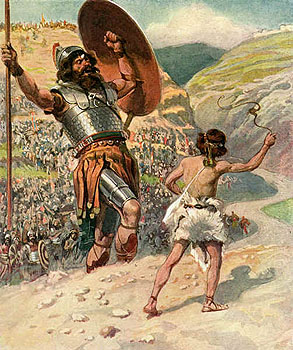
Then there’s the story David and Goliath. David may have been too young to join the army, but he brought down the giant Goliath with nothing more than a sling shot. In my memory, the pictures of Goliath make him out to be a Paul Bunyan-like figure, though the most reliable biblical texts put him closer to 6 foot 9. That’s tall, but closer to Magic Johnson than Paul Bunyan. Still, that’s quite a fete for a young shepherd boy.
There are also women who figure prominently in the biblical story. They may lack brute strength, but they possess courage and wisdom and they too accomplish great things. There’s the story of Deborah who judges Israel and leads them in battle during a critical time when no man would step forward. There’s Miriam, the sister of Moses and a prophet in her own right, who helps lead the people across the desert. And Esther risks her life and her position in the court of the Persian king to protect her people. They too act with the power of God within them.
The message in all of these stories is simple – extraordinary fetes can happen when one is acting within the power of God. Or, as Paul writes to the Philippians: “I can do all things through Christ, who strengthens me.”
Not only that, but Paul, writing from prison, can say to the community“rejoice in the Lord always.” Although Paul isn’t claiming superhuman powers, he does invite us to live joyfully even during difficult times. But, in spite this call to live joyfully in the Lord, many of us adopt the philosophy of the Stoics. There are probably lots of Stoics in our world – perhaps you’re a Stoic and you didn’t even know it. You could describe a Stoic as a person who has learned to endure life troubles. That is, they have learned to “grin and bear it.” They will endure, but there will be no joy. Is that you?
Stoics are realists, but they’re also not the most pleasant people to be around. Of course we may prefer them to the person who whistles a happy tune while pretending that nothing bad is happening to them or to the world around them. We sometimes speak of such a person as one who’s living in denial. Is that you?
Then there’s Chicken Little who is always complaining that the sky is falling. Nothing good is ever going to happen in life. Our best days are behind us and so we might as well find the bomb shelter and hide out until the end. Is that you?
Paul is a realist, but he’s not a Stoic, doesn’t live in denial, nor is he a complainer. What he is, is a person who can find joy in life even while being in prison. Paul was no stranger to calamity, experiencing everything from shipwrecks to beatings. And if that isn’t enough, he tells the Corinthians that God has afflicted him with a “thorn in the flesh” that keeps him grounded after receiving visions and revelations (1 Cor. 12:7).
Paul knows what it’s like to live with nothing and with plenty, but he has also found a way of being content with where he’s at in life. This is the source of his joy. He has found his contentment in God’s presence. Therefore, he can rejoice in all things and at all times, and can tell the Philippians not to be anxious, but instead take their concerns to God in prayer with thanksgiving – even when things aren’t going so well – sort of like what’s happening in our country right now.
I’ll make a confession here. I struggle with this passage. As much as I’d like to rejoice at all times, I get anxious about things and while I’m a fairly happy person, I have my moments. I’ve known good times and not so good times, and I’ve come through okay, but I’m not always content nor do I rejoice at all times. But then, I expect I’m in good company.
There’s a book that’s titled Flunking Sainthood. Does that sound like you? Have you tried yur best to be holy, to pray unceasingly, and take every problem to God in prayer with thanksgiving? Are you an A+ or even a B+ student in sainthood? Or, like me, do you struggle with your halo? When it comes to sainthood, unless the bar is set really low, I think I fail to make the grade. There are times, too many to count, where my mind focuses on things that are less than honorable and that aren’t necessarily commendable or excellent or worthy of praise.
Does that sound like you? Have you tried yur best to be holy, to pray unceasingly, and take every problem to God in prayer with thanksgiving? Are you an A+ or even a B+ student in sainthood? Or, like me, do you struggle with your halo? When it comes to sainthood, unless the bar is set really low, I think I fail to make the grade. There are times, too many to count, where my mind focuses on things that are less than honorable and that aren’t necessarily commendable or excellent or worthy of praise.
Whether or not we’ve reached perfection in this calling, Paul invites us to find joy even in the midst of difficult times and to do this we must think about life differently. And the key seems to be moving away from a theology of scarcity to a theology of abundance.
When I talk about a theology of abundance, I’m not talking about a prosperity gospel where we name it and claim it and our dreams come true. But, in a theology of abundance we stop thinking that there are limits to God’s presence, that there’s not enough of the Spirit to go around, so if you have some thing then there might not be enough for me. This is true of power, money, and food.
There are a lot of hungry people in the world. We’ll meet some of them when SOS comes to the church next weekend. We know that people are hungry, but many of us throw away food or we eat more than our bodies can process? Why is that? Evolutionary biologists would tell us that this is part of genetic makeup, and we’ve not evolved enough to get beyond this fear of not having enough. So, when we think that there’s not enough power or money to go around, we pull inward, and hoard what we have, and we ignore the common good. But in this there is no joy.
Bruce Epperly spoke to this issue in his sermon a few weeks back. More recently, in comments made about this passage, he has written:
Faith opens us to new dimensions of reality, in which we have all the resources we need to face the challenges of each day. Amid bottom lines and apparent marginalization, faith sees evidence of God’s providence: a mustard seed becomes a great plant, five loaves and two fish can feed a multitude, and persecutors can become proclaimers.
So, when you look at the world through the eyes of faith, what do you see? Do you see God at work opening up new possibilities? Do you see the Spirit empowering people to do great things – maybe not superhuman fetes of strength, but great things? Do you believe that there are enough gifts and resources present in this rather small congregation so that we might affirm the word that Paul gave to the Philippians from his jail cell? “I can do all things through Christ, who strengthens me.”
In a moment we’ll dedicate the third of our new little ones. We don’t know what the future holds for her. There may be difficult times ahead. But that’s life. There will also be great opportunities for her to experience God’s presence and to live into God’s vision for her life.
And as for the rest of us, what will be the legacy we leave her? What will be our witness? Will it be one of abundance or scarcity? Will we model for her and others a vision of reality that is full of joy and thanksgiving? The choice is really ours. If we take up God’s invitation, Paul says there will be peace and there will be joy in abundance!
Preached by:
Dr. Robert D. Cornwall
Pastor, Central Woodward Christian Church (Disciples of Christ)
Troy, Michigan
17th Sunday after Pentecost
October 9, 2011
Comments